
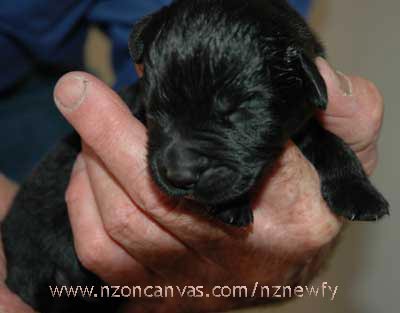
We are often asked how big Newfoundland pups are when they are born.
Newfoundland dogs start life very small. This Newfoundland pup (Henry or one of his littermates) is just five days old.

To the right is Wellington at four months old. In his prime Wellington weighed in at around 70 kgs, toward the larger end of the scale for a male Newfoundland dog in New Zealand. The largest Newfs we have seen have been around 85 kilos, but we have heard of them going well beyond that.

Here Wellington keeps our young friend Shelby company at breakfast time. Newfoundlands eat a lot when they are growing, but as adult dogs tend to take less feeding than you may think.

Many people think you need a huge sheepstation or ten acre block to keep a Newf. In fact Newfoundland dogs are fine in reasonably confined spaces and make great family dogs. They were bred to spend a lot of time on fishing boats in Newfoundland.
When fully grown, Newfoundland dogs need a good walk every day but care should be taken not to excersise a young Newf too vigorously. A very short walk is safe after a few months until the pup reaches about a year of age, when his / her bones have strengthened enough to take all that weight.

...A Newfoundland dog usually also enjoys a swim as often as possible.


Like most Newfoundlands Wellington enjoyed carting...

...Posing while carting...

...Anything to do with snow...

...and children...

He liked spending time with his "cousin" Kelsey, the Shetland Sheepdog, pictured here as a pup with our sister Maree.

Right and below, Wellington at almost eight years old meets Kiwa, a nine week old Newfoundland pup bred by Ellen & Mick Dabner. Kiwa lives with our friend Hadyn in Christchurch and is big brother to one of our other Newfoundland dogs, 'Henry'.

A cute and cuddly Newfoundland pup often turns into a big, boisterous teenager who wants to be in charge of your pack. Wellington was no exception.
Training for you and your Newf from a very early age is absolutely essential.

Thirteen months after the above photo was taken Kiwa had gained a few kilos...

...and the boys enjoy a swim together at a north Canterbury beach.

Here they are another few months later taking a river swim.
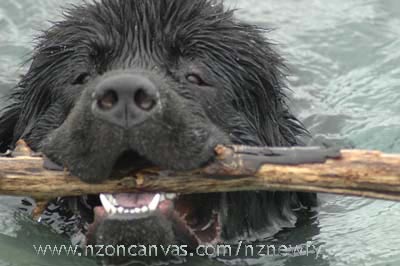
A wet Newfoundland is a happy dog...

...The wetter the better!

We think Wellington was still a very handsome chap at ten years of age.

Here (right) are Wellington's Newfoundland friends Topsy & Magnum. They seem to be into Christmas and we reckon Charlotte, their mum might be into icecream.
Due largely to their size, Newfoundland dogs have a life expectancy of only around ten - twelve years.

This is Wellington's litter mate and brother Hootie at around two years of age. What a face!


We took Wellington out and about as much as possible, usually to the delight of the people we met. When Wellington reached ten years of age he was no longer up to lengthy walks. A short stroll around the block & plenty of rides in the car were more suitable.
Over the years we have been seriously asked many times if Wellington is a dog or a bear. At least once every walk someone would ask the obligatory "Have you got a saddle for him?" One of the best questions was "When will he turn black?". Newfoundlands come in four colours. Black, White and black (Landseer), Brown and very occasionally grey. Both blacks and browns sometimes have splashes of white.

Here's our old boy on his eleventh birthday. He was no longer up to much, even a short walk was a big effort. Although he needed a hand to get in the car he still enjoyed going places.
Despite the deterioration of his mobility he remained happy and alert until his body gave out during his thirteenth year.

Please note that all images on this site are copyright.

